Your child buttoned their shirt by themselves this morning. It took six months of practice, two rounds of occupational therapy, and more patience than you thought you had.
And then you moved on to the next thing — breakfast, school bag, the morning rush — without stopping for even a moment to say: that was extraordinary.
If that sounds familiar, you’re not alone. Parents of children with special needs are among the most dedicated people on earth. But so many carry an invisible weight: the feeling that progress isn’t happening fast enough, or isn’t worth celebrating unless it’s a big, official milestone.
Here’s the truth the science is clear about: celebrating small wins — consistently and intentionally — is one of the most powerful things you can do for your child’s development, your family’s resilience, and your own wellbeing. In this article, you’ll learn why incremental progress matters far more than we realize, what’s happening in your child’s brain when you celebrate a win, three insights rarely covered in special needs parenting content, and a simple daily practice any family can start today.
What Counts as a Win for a Child with Special Needs?
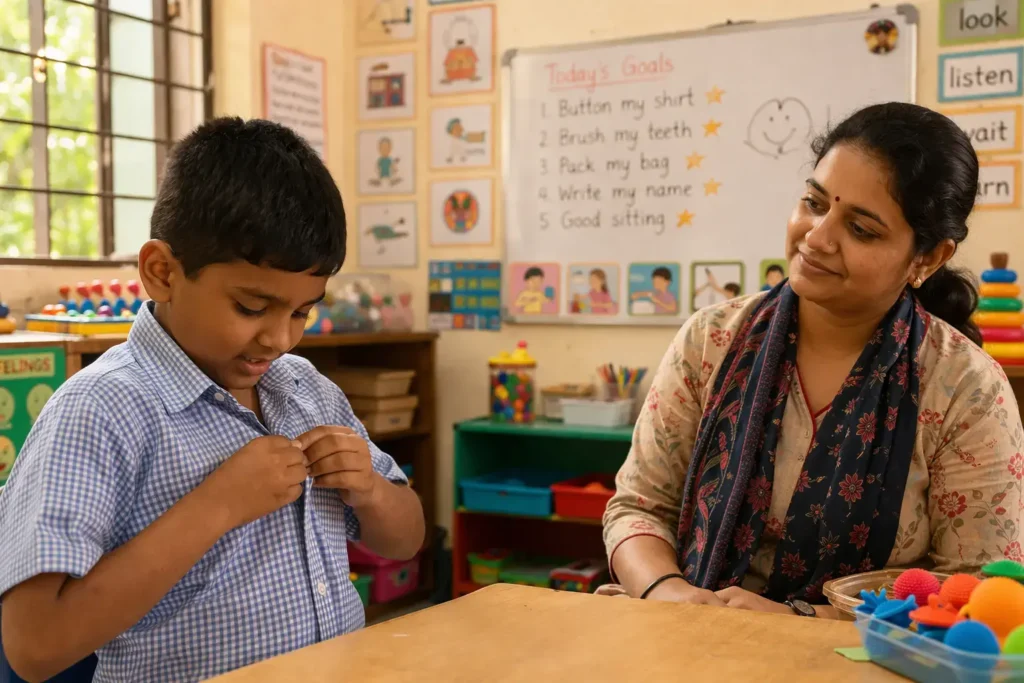
Before anything else, we need to redefine the word ‘milestone.’
The standard developmental charts — first words by 12 months, walking by 15 — weren’t written for your child. For a child with autism, intellectual disability, or cerebral palsy, milestones look different. And that’s not a problem. It’s just a different map.
A small win might be:
- Making eye contact during a conversation for the first time.
- Tolerating a new texture at lunch without distress.
- Completing a vocational task like folding paper or threading a needle independently.
- Saying a new word, signing a new sign, or using a communication device to express a need.
- Sitting through a full therapy session without becoming overwhelmed.
- Greeting a classmate by name.
None of these make the evening news. But every single one represents your child’s nervous system rewiring itself — building new neural pathways through repetition, safety, and encouragement.
The Neuroscience: What Happens in Your Child’s Brain When You Celebrate
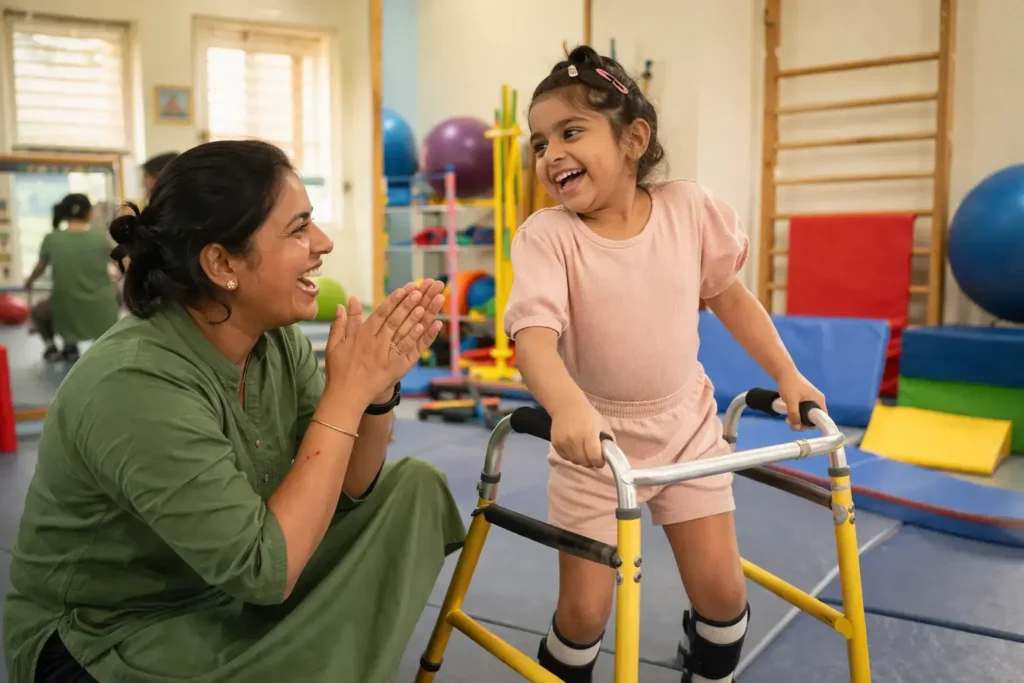
Dopamine and the Learning Loop
Every time a child completes a task — any task — the brain releases dopamine, the neurotransmitter linked to pleasure, motivation, and learning. This isn’t just feel-good chemistry. Dopamine actively reinforces the behavior that produced the win.
For children with autism or intellectual disability, whose dopamine regulation may work differently, this external acknowledgment of success becomes even more important. When you celebrate — with a clap, a high-five, a specific word of praise, or a small reward — you are helping the brain tag that behavior as worth repeating.
Over time, this becomes a learning loop: effort → success → celebration → more effort. It’s the biological foundation of habit formation and skill-building.
The Progress Principle — and Why It Applies to Every Child
Harvard Business School researchers Teresa Amabile and Steven Kramer identified what they called the Progress Principle: of all the things that motivate human beings, making progress in meaningful work is the most powerful.
This was studied in workplace settings — but the neurology is universal. Children with special needs are doing some of the most demanding cognitive and physical work of their lives every single day. They are climbing mountains that most people never see.
When that progress is noticed and named, it matters enormously — not just emotionally, but neurologically.
3 Insights Rarely Found in Special Needs Parenting Content
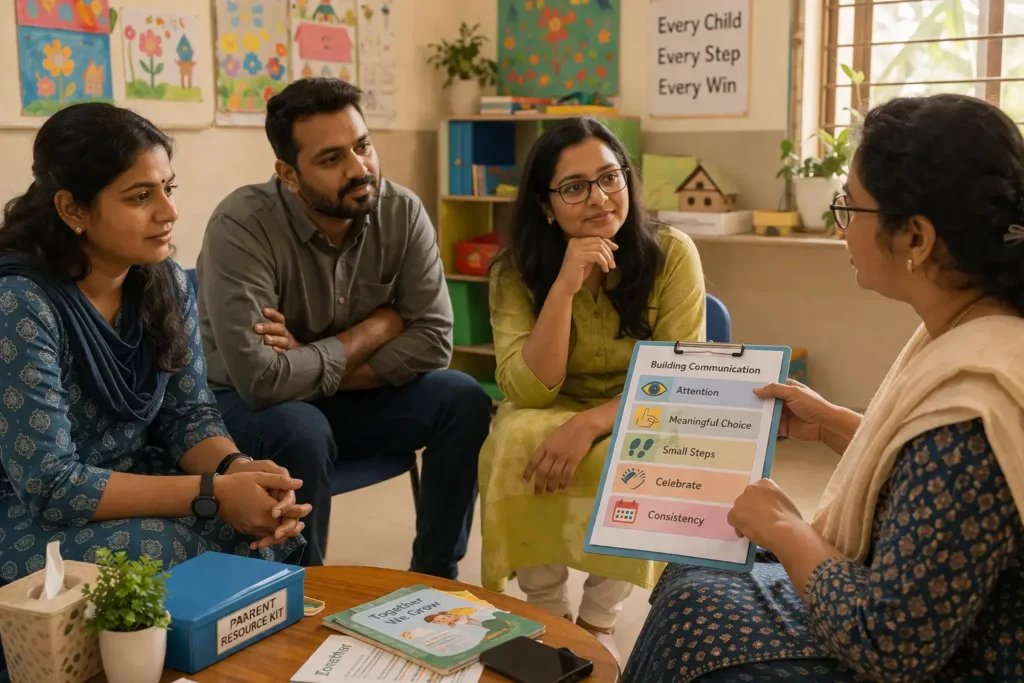
1. Negativity Bias Hits Harder in Caregiving — And Small Wins Are the Antidote
Psychologists have established that negative experiences register more powerfully in the human brain than positive ones of equal size. For parents of children with special needs, this effect is amplified.
A difficult therapy session, a public meltdown, a form that didn’t come through — these moments land hard. Meanwhile, the ten small things that went right that same day go unrecorded and uncelebrated.
Actively tracking and celebrating small wins isn’t just optimism. It is a deliberate, evidence-based strategy to rebalance this cognitive bias. Parents who build this habit report less chronic stress, more resilience on hard days, and a fundamentally different emotional baseline.
2. Celebrating a Win Opens a Learning Window in the Brain
Here’s something that rarely gets discussed: the moment after a success is neurologically significant. When a child (or a parent) pauses and acknowledges what just happened, the brain has a brief window to consolidate what worked — to convert short-term experience into long-term behavioral memory.
This is why at SOREM, educators and therapists don’t just move immediately to the next task after a breakthrough. The pause — the acknowledgment — is part of the intervention. It’s not a soft, feel-good extra. It’s how learning sticks.
3. Parent Celebration Directly Affects Child Self-Efficacy
Psychologist Albert Bandura’s research on self-efficacy — a person’s belief in their own ability to succeed — found that young children build this belief primarily through two sources: their own mastery experiences, and the reactions of people they trust.
You are that person. When you visibly celebrate your child’s progress, you are not just making them feel good. You are handing them evidence, in the most credible form available to them, that they are capable.
For children who face repeated difficulty and comparison, this evidence matters more than almost anything else.
What Happens When We Skip Celebrating Progress

When small wins go unacknowledged consistently, the effects build up:
- Children lose intrinsic motivation. The effort stops feeling connected to any positive outcome.
- Parents experience accelerated caregiver fatigue. Without visible markers of progress, the journey feels endless.
- Families lose a shared language of hope. The emotional texture of home shifts toward deficit — what isn’t working — rather than growth.
- Therapy and education become transactional. Children attend sessions but don’t connect the effort to a sense of personal achievement.
None of this is permanent. It shifts the moment a family deliberately builds a celebration practice — however simple.
A Simple Daily Practice: The Family Win Journal
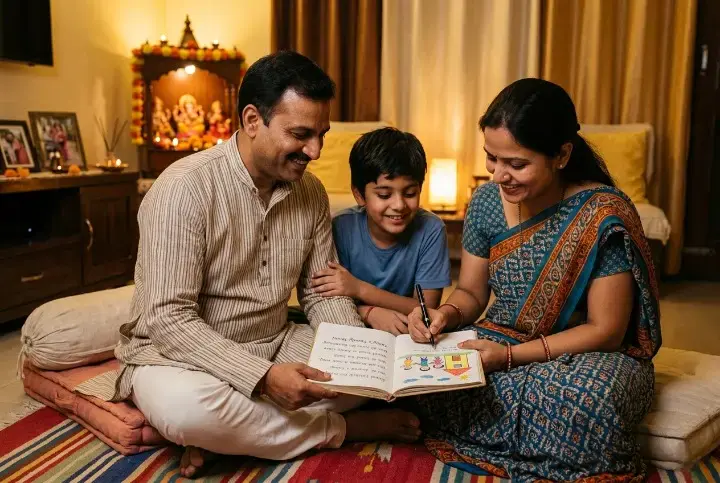
You don’t need a system, an app, or extra time. This takes three minutes at the end of the day.
Ask two questions:
- What did my child do today that they couldn’t do before — or did better than before?
- How did I support that?
Write one line for each. That’s it.
Over weeks, this journal becomes something powerful: a record of real, specific progress that you can return to on the hard days. It counters the memory’s natural bias toward difficulty. It makes the invisible arc of growth visible.
Make It Specific. Make It Shared.
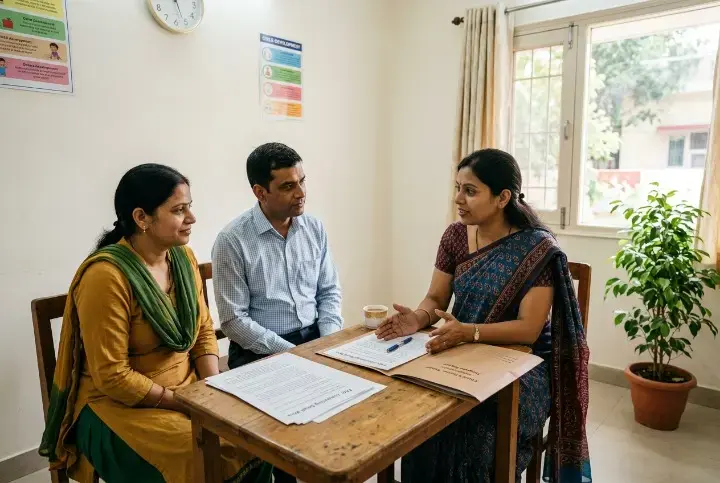
Name the win out loud, directly to your child. Not ‘you did great’ but ‘you asked for water using your words — I am so proud of that.’ Then share it with someone: your partner, a teacher, a therapist, a WhatsApp message to a trusted friend. Research by Harvard’s Ashley Whillans shows that recognition shared socially amplifies its psychological impact — for both the giver and the receiver. When a SOREM teacher messages a parent to say ‘Arjun sorted all the shapes by colour independently today,’ that message does more than inform. It anchors progress in reality and in relationship.
Scale the Celebration to the Size of the Win
Not every win needs a big response — and a mismatch can feel insincere to older children. Build a range:
- Micro wins (daily): A specific word of praise. A high-five. A note in a book.
- Weekly wins: A favourite meal, a chosen activity, extra screen time, a family outing.
- Monthly milestones: Something memorable — a special outing, a photograph, a certificate, something the child can see and hold.
FAQ: Celebrating Small Wins for Children with Special Needs
My child doesn’t seem aware of praise. Does celebration still help?
Yes — though the form of celebration may need to adapt. For non-verbal children or those with limited social awareness, the celebration works through the dopamine loop rather than through social understanding. Pairing praise with a preferred sensory reward (a favourite texture, sound, or activity) can anchor the positive reinforcement even when verbal praise doesn’t land directly.
I’m exhausted. How do I celebrate my child’s wins when I’m running on empty?
Start smaller than you think you need to. A single sentence, said out loud, at the end of the day: ‘You did something hard today, and you didn’t give up.’ That sentence, repeated, matters. Caregiver burnout is real and serious — and one of its early signs is the inability to register positive moments. If you’re there, please reach out: to a counsellor, to SOREM’s parent support network, to someone who can help you carry the load.
Won’t celebrating too much create unrealistic expectations?
No. The research is consistent: children who receive specific, honest praise for genuine effort and real achievement develop more accurate self-assessment, not less. The fear of ‘over-celebrating’ reflects a misunderstanding of how encouragement works. Hollow praise (‘you’re the best!’) can distort self-perception. Specific praise (‘you remembered to zip your bag — that’s a new skill’) builds an accurate, confident sense of self.
How SOREM Builds a Culture of Celebrated Progress
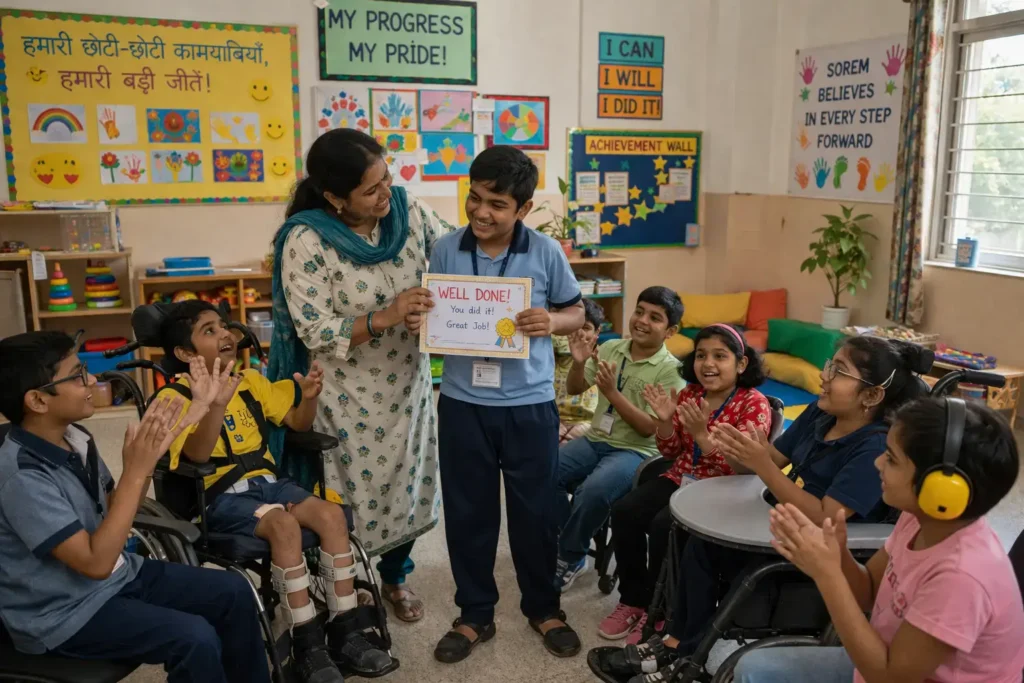
At SOREM School in Chandigarh, celebrating small wins isn’t an afterthought — it’s woven into the fabric of every day.
Every child at SOREM has an Individual Education Plan (IEP) or Individual Training Plan (ITP) — a personalized roadmap that breaks larger goals into specific, achievable steps. This means every week, every month, there are clear, defined moments of progress to recognize.
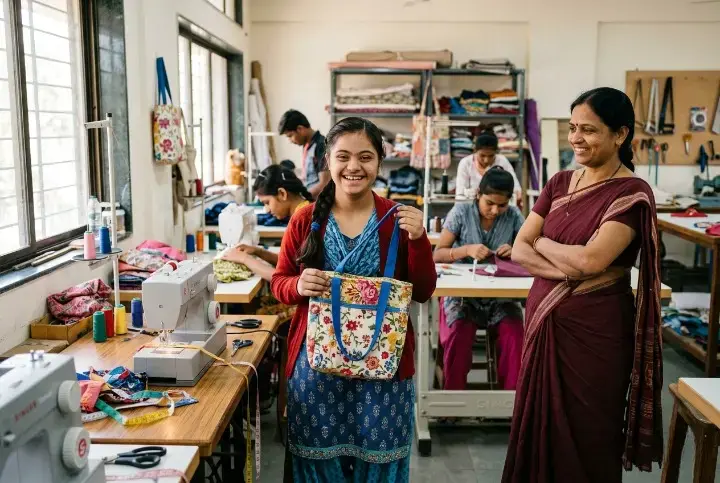
The Sheltered Workshop gives young adults the experience of completing real work and earning real stipends — tangible, celebratable proof of skill and independence. Sports programs like the Special Olympics create public platforms for achievement. Therapies across speech, occupational, music, and dance create daily wins in the areas where children have worked hardest. And the families notice. Across the testimonials of SOREM parents, the same words appear again and again: blossomed, flourished, confidence, proud. These aren’t accidents. They are the cumulative result of thousands of small wins, acknowledged and celebrated.
Key Takeaways
- Every step forward matters — even the ones that look small from the outside. For a child with special needs, they are rarely small at all.
- Dopamine and self-efficacy research confirm that celebrating wins — specifically and sincerely — accelerates the learning process and builds lasting confidence.
- Negativity bias is real for caregivers. A daily win journal is a practical, evidence-based way to rebalance it.
- Specific praise works better than general praise. Name what the child did. Connect it to effort and growth.
- Scale celebrations to the size of the win — but always mark the moment in some way.
- You don’t need to do this alone. Teachers, therapists, and a supportive community can share in celebrating your child’s progress — and that shared recognition amplifies the impact.